Étiquette : Smart City

  • The future of urban deliveries with robots

    The future of urban deliveries with robots

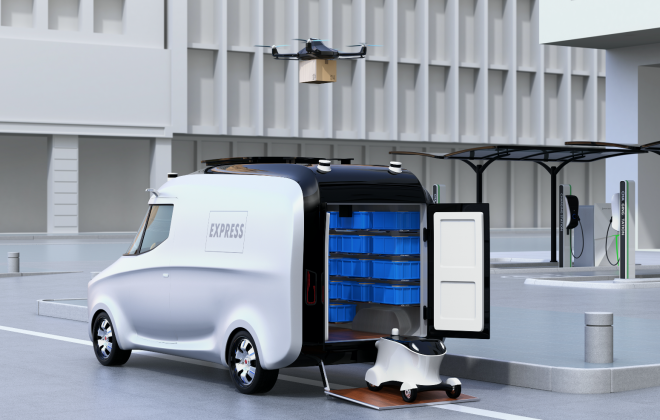
    In recent years we have seen an increase of experimentations with drones and robots for last-mile deliveries. There are experimentations with drones for deliveries in suburban or rural areas based at specific drone ports[1]. Others are experimenting with van based drones for increased efficiency when delivering goods in areas where delivery points are further apart than in highly urbanized settings[2]. Other experiments are performed using robots for deliveries, one of the first robot delivery use cases was pizza delivery[3]. In urban, settings autonomous deliveries are becoming an increasingly important topic with significant investments looming but also with major regulatory subjects to address[4]. 
    If we examine the different possible use cases for robot and drone deliveries, we quickly realize that a significant use of drones is not to be expected soon in densely populated areas, however slow driving robots become an interesting alternative in settings with restricted access for vans and cars as they are usually smaller, slower, quieter, and cleaner than car or scooter based deliveries. Several experiments have been performed on campuses and pedestrianized areas[5]. It seems that in the future we will see a lot more of these experiments as the promise of increasing efficiency and reducing cost by not needing delivery personnel is attractive to many companies. Just very recently a new fast food truck has been tested in Shanghai permitting some sophisticated interaction with the robotic delivery vehicle: Clients can choose and pay their food directly at the vehicle[6].

    These very exciting technological developments raised interest in the Anthropolis chair’s team. It made us think about the operational possibilities and implications of such a technology. In a recently defended PhD thesis[7], PhD student Shoahua Yu investigated various operational aspects related to robotic deliveries. The main idea was to look at “mothership” variants of the problem.

    • First, two-echelon urban deliveries using robots for 2nd-level route delivery were considered. In this concept, the mothership van carries robots on the 1st-level route and drops them off and picks them up at rendezvous nodes, while the robots handles deliveries on the 2nd-level routes. In this first version, only robots are able to deliver to customers. Our target areas are pedestrianized zones in city centers or campuses. We proposed mathematical models to simulate various test cases and performed a sensitivity analysis for vehicle speed combinations revealing that increasing robot speeds has only very limited benefits. We therefore recommend to keep robot speeds rather low for a pedestrian-friendly insertion into the urban environment.
    • As we considered battery powered robots and vans, we extended our models to incorporate range restrictions and recharging operations for vans and robots. We allowed robots to be recharged in the vans during recharging stops but also en-route. A sensitivity analysis for vehicle charging modes, maximum battery capacities, and charging rate shows that using en-route charging while increasing battery level and charging rate can have beneficial effects on operational costs.
    • We finally considered a very general problem variant where robots and vans are performing pickup and delivery operations in city. Robots can visit areas with van access restrictions, such as pedestrianized areas or university campuses. The van stops at parking nodes to drop off and/or pick up its robot, and to replenish its robot and/or swap its robot’s battery if needed. In a case study considering the city of Xi’an, we performed a comparative analysis with more classical delivery approaches. It showed the operational competitiveness of the proposed robot delivery system.

    As our research has demonstrated, robot based deliveries can be very cost-effective from an operational point of view in comparison with more classical delivery approaches explaining the increased industrial interest in such technologies. Other researchers have shown that energy consumption and CO2 emissions can be significantly reduced in urban area through the introduction autonomous robot deliveries[8].

    We can therefore be quite optimistic about these technological developments as they are expected to decrease delivery costs and reduce negative environmental impacts of deliveries. However, they will also pose some societal questions, as human interactions will be further reduced. There exists ideas on combining robotic conveyors with human porters in densely populated areas to ensure personal local services with a human touch[9]. However in times of the pandemic crisis a big push towards services that are not requiring personal contact has been observed. Such developments will further increase the interest in robot based deliveries not needing any human interaction. An expected further increase in urban deliveries will reduce the attraction of urban centers with local shopping possibilities changing the face of our cities. We can expect substantial technological and operational advances in the years to come with regards to robotic deliveries. As every technological leap, these developments will have economic and societal consequences that will affect the way cities will function.

    Collaboration between economic actors, researchers and municipalities will be required to use those novel technologies in a way that will increase urban quality of life by reducing traffic and other inconveniences. This will be achieved by coordinated interplay between the different stakeholders, increasing the quality and efficiency of deliveries, and at the same time ensuring livable and living quarters. In our ongoing research project LEAD[10]. We create Digital Twins of urban logistics networks in 6 cities (Madrid, The Hague, Budapest, Lyon, Oslo and Porto), to test and represent different innovative solutions for city logistics, to address the requirements of the on-demand economy while aligning competing interests and creating value for all different stakeholders. IRT SystemX is mainly contributing to the design and development of the overall digital twin concept and library as well as the developments for the Lyon living lab. In one of the Lyon test cases we will investigate the use of robot based deliveries in dense urban settings.

    So please stay tuned for more research results on this exciting topic!

     

  • A glimpse of Smart City

    A glimpse of Smart City

    By 2050, 70% of the world population is likely to live in cities. Albeit, the footprint of cities only represents a few percentage of Earth surface area, but is a major contributor to pollution. Therefore, a legitimate quest is launched for optimizing resources and organization for the sake of the well-being of inhabitants. Hence, a concept of smart city aroused few decades ago and, by the same token, a technology fantasy that would revolutionize urban way of life inherited from thousand years of collective history. Is this reality? Lyon and Singapore will be providing a realistic glimpse of smart city in the course of this article.

    City. Today, understood as an important town [1], originally coming from the French word, Cité, itself rooted in civitas, the latin description of a city-state [2]: a community of free citizens. Between Latin and English, the meaning has switched from the inhabitants to the place, and by the same token so does the understanding of city evolves over times and space. History is made. What about the future?

    Smart city. A label encompassing a future vision of an improved city. It originates from a private-business led trend in the late 20th century, promoting the use of technology to improve urban life, and in the meantime creating a new commercial market. Marketing wise, “Smart” offers a wider shade of inspiration than its French counterpart “intelligent”. So much wider, that different points of views are controversial and therefore the notion itself of a smart city shall always be defined before arguing about it. It seems that “natural” intelligence has regained strength over the initial approach purely based on “artificial” intelligence, for the sake of the collective interest.

    As a basic, a common understanding of the smart city concept would be the sustainability of the urban area, using collective intelligence with Digital technology as key enabler [3]. Either way, the topics covers larger areas of sciences (legal, social, computer science, biology, geography…), and a wide variety of applications (policy, infrastructure, health, education, mobility, energy, housing…). Let’s get a humble slice of it, looking at two footprints of the IRT SystemX in Lyon and Singapore.

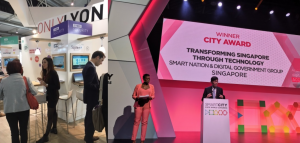
    So far away, yet so close? Both cities attend the Smart City Expo World Congress held annually in Barcelona [4]. A show where primarily territories compete for exposure hoping in return to get favor of investors, and possibly new citizens: in 2018, Singapore won the city award. Yes, smart city is also a business, at least in the “western” world.

    Lyon: French pioneer of smart cities

    SystemX had the opportunity to join the Lyon Metropole booth during 2017 and 2018 edition with different communication aspiration. Interestingly, SystemX was a contributor to both of them.

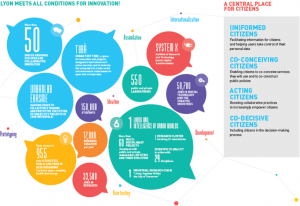
    Co-construction. In the 2017 edition, SystemX featured its smart territory activities (an extended concept of the smart city) lying in mobility, energy and blockchain [5], while Lyon metropole smart-city communication strategy stressed on the “CO”, meaning collective, collaborative, partnership based, contributive, open, public-private-people etc. To this end, the booth highlighted 2 key components: Experimentation– Lyon urban area as a playground for experimentation and an Innovation Ecosystem, including dynamic companies, research institutes, collaborative places, fablabs… and last but not least citizens, as the core stakeholder.

    Truly so, the greater area of Lyon fosters distinctive smart city accelerators ranging from academics (i.e. labex), to start-ups (i.e. tuba) and industrials (i.e. Cara European cluster). In that respect, SystemX provided a true leverage for this dynamic ecosystem with its ability to build collaborative projects fostering innovation based on real use case scenario. As an example, the project definition of LCE (Lyon Covoiturage et Expérimentations) kicked off the same year, integrated Lyon’s will to include different partners to boost and test carsharing solutions over his territory [6].

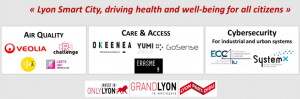
    Digital security. In 2018, Lyon metropole message focused on driving health and wellbeing for all citizens. Alongside air quality, care and access, the booth underlined cybersecurity as a key concern for the smart city resilience and therefore citizen protection. Again, SystemX was well suited to share its digital security research domain and field of investigation.

    It is worth mentioning that the metropole of Lyon operates several urban systems (water distribution, waste management, traffic regulation…) critical for everyday urban life. Although these systems are not always visible to citizens, they are getting more and more connected, and therefore vulnerable to cyber-attacks. The connectivity is a real added value to smart city implementation as it fosters data cross fertilization. The metropole of Lyon implemented a proactive data strategy : providing a single publicly run data platform that provides access to over 1000 sets of qualified and reliable data, from local public and private partners. Different licenses were designed to regulate the reuse of strategic data and build a trustful environment. For the last 2 years a specific focus was made on personal data management to ensure privacy and citizens’ empowerment on data. As another example of SystemX contribution to this goal, the BWM (Blockchain Wallet de la Mobilité) project is an innovative step forward powered by blockchain to the current deployment of a citypass giving access to public and private services to Lyon inhabitants.

    Singapore: The 1st Smart Nation in the world?

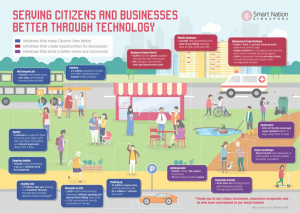
    In Singapore, the concept of Smart City has been extended from 2014 to the Smart Nation one. Yet in 2014, the Prime Minister launched the Smart Nation initiative, with a view to:

    • Making Citizens’ life better
    • Creating opportunities for Businesses
    • Building a better home and community (see picture below)

    This tremendous initiative is headed at the highest level of the government, and financially supported by a significant budget. If we only consider the scope of Research and Innovation, where stands SystemX, 19BSG$, that represent more than 12 Mds€, are dedicated to the digital transformation of the country in a 5 years plan. This has to be compared to the Horizon 2020’ 5 years budget of 80 Mds€ for the whole of European Union.

    This transformation is focusing both on the public and private sectors, with all governmental bodies involved in order to financially contribute and set the pace for all key involved players coming from business, research, innovation, and public bodies.

    If you go one step deeper into the objectives, you will find the same topics as in most other big cities.

    Mobility, energy, security, health, sustainability, housing, education, infrastructures, are priorities, in no order of preference.

    Part of this massive transformation is Mobility, supported by the Smart Mobility 2030 Strategic Plan [7]. This is where SystemX came into play in Singapore, starting in 2018. SystemX came to Singapore in order to join the 1stworldwide project to build a center of excellence for the certification of the autonomous vehicles (AVs), namely the CETRAN (Centre of Excellence for Testing & Research of AVs – NTU) project. This is a flagship project for Singapore, willing to set worldwide standards for the development of AVs in megacities. In cooperation with its main partner, the Nanyang Technological University (NTU), SystemX is bringing its expertise on simulation and modelling in AVs to Singapore, together with French key partners, Renault, SNCF, Systra, and AV Simulation [8]. For SystemX, it is a highly competitive challenge, and also a way to cooperate with some of the best players in the world, be it from academia or industry. It opens new doors of development for the IRT and its human resources.

    In addition, SystemX develops contacts in other industry sectors within this Smart Nation, including energy, logistics, or cybersecurity. French companies are also part of this momentum. To name a few, Airbus, Thalès, ENGIE, EDF, PSA, Bolloré, Blue Solutions, Systra, Alstom, Safran, SopraSteria and many others use Singapore as an R&D platform to build the future of their business in Asia.

    As artificial intelligence is becoming a more and more key enabler, SystemX is also looking at partnering with academia on this unlimited chapter. NTU, NUS, A*STAR, or SUTD, are among the world best ranked academic players to do so. This is also a way for SystemX PhD students to spend time abroad in competitive research teams and bring back new expertise to France.

    To sum up, Singapore appears like a living lab where the world is coming to explore, innovate, and test technological solutions that will later on benefit to other countries. It is clearly the place to be for an Institute like SystemX and we see no limit to this cooperation.

    ———————————————————————————————————————————————————————————–

    If one tries to compare two cities like Lyon and Singapore, one may realize that key topics are very similar (mobility, energy, security…). However, the approach used to tacklethese issues might be different.

    Lyon and its surrounding suburbs was the first area to be granted the full status of French metropole in 2014. It acquired the largest set of competences a French public organization can get, after the state. As a city-state, Singapore gathers even more prerogatives, and hence long tem responsibilities.

    One example is water. Singapore has been dependent from Malaysia since before the creation of the country (1965), with 2 long term agreements signed in 1961 and 1962 to supply Singapore with water. One of these agreements ended in 2011, and Singapore managed not to renew it by putting in place the NEWater programme, focusing on recycling and desalination of water. This is a key milestone in Singapore independence and sustainability.

    The metropole of Lyon doesn’t need to bother much with foreign neighbour. However, it dedicates a lot of attention to protecting its citizens, and settles himself as a leader in strengthening people’s data , against the private digital champions. A pre occupation widely spread in Europe.

    In the end, megacities share a lot of concerns in order to improve their citizen’s lives. They address these issues according to their own culture, priorities, and skills. Comparing their strategies, methods and have them cooperate will allow fastest and innovative ways to progress. This is why SystemX is present in Singapore and Lyon: think out of the box and be humble and curious about what other players develop elsewhere.


    References:

    [1] https://www.lta.gov.sg/content/dam/ltaweb/corp/RoadsMotoring/files/SmartMobility2030.pdf

    [2] http://erian.ntu.edu.sg/Programmes/IRP/FMSs/Pages/Centre-of-Excellence-for-Testing-Research-of-AVs-NTU-CETRAN.aspx

    [3] https://www.cerema.fr/fr/actualites/qu-est-ce-qu-smart-city

    [4] http://www.smartcityexpo.com/en/home

    [5] https://www.irt-systemx.fr/en/feedback-on-smart-city-expo-world-congress/

    [6] http://assisescovoiturage.com/

    [7] https://www.lta.gov.sg/content/dam/ltaweb/corp/RoadsMotoring/files/SmartMobility2030.pdf

    [8] https://www.irt-systemx.fr/en/project/asv/